MKS CMAT · Verbal Ability
CMAT Vocabulary in Context: Meaning, Clues and Practice
CMAT vocabulary in context asks more than whether you have seen a word before. The surrounding sentence controls meaning, tone and grammatical role. A familiar definition can still be wrong if it does not fit that sentence.
These original MKS examples teach a method. They are not an official TU vocabulary list or recalled past-paper questions.

YOUR LEARNING ROUTE
Build the skill. Then apply it.
Use the sentence as evidence
Look for definition or restatement
A sentence may explain the word immediately: “The instructions were ambiguous; two students understood them in different ways.” The second clause points to “open to more than one interpretation.”
Notice contrast and cause
Words such as but, although, because and therefore reveal relationships. “The old method was slow, but the new process was efficient” suggests opposite qualities.
Check tone and grammar
Decide whether the missing meaning should be positive, negative or neutral, and whether the word acts as a noun, verb, adjective or adverb. Then test each option in the full sentence.
Learn a useful word family
Connect analyse, analysis, analytical and analytically. Word families make reading and sentence-completion practice more useful than memorising isolated pairs.
Six original questions
Q1. Meticulous
“Sita was meticulous when checking the application; she reviewed every field twice.” Meticulous most nearly means:
- A. careless
- B. very careful
- C. impatient
- D. uncertain
Q2. Mitigate
“The team added a second route to mitigate the risk of arriving late.” Mitigate most nearly means:
- A. increase
- B. hide completely
- C. reduce the severity of
- D. predict exactly
Q3. Ambiguous
“The instruction was ambiguous, so two groups interpreted it differently.” Ambiguous most nearly means:
- A. open to more than one interpretation
- B. written in a friendly tone
- C. supported by strong evidence
- D. impossible to read aloud
Q4. Pragmatic
“Rather than redesigning the entire schedule, the coordinator chose a pragmatic solution that could be used immediately.” Pragmatic most nearly means:
- A. purely theoretical
- B. practical
- C. expensive
- D. traditional
Q5. Obsolete
“Once the digital system was adopted, the old paper process gradually became obsolete.” Obsolete most nearly means:
- A. newly invented
- B. legally required
- C. no longer in use
- D. difficult to carry
Q6. Credible
“The claim became more credible after the report linked it to verified records.” Credible most nearly means:
- A. believable
- B. surprising
- C. incomplete
- D. unpopular
PAUSE · CHECK · IMPROVE
Use the next section as an action step.
Keep your working and source notes. Record what was uncertain, then choose one small correction or verification task before moving on.
Answers and clue analysis
Q1 — B, very careful. Reviewing every field twice is the contextual evidence. The behaviour is deliberate, not careless or merely uncertain.
Q2 — C, reduce the severity of. A second route lowers the risk; it cannot guarantee removal or predict the delay.
Q3 — A, open to more than one interpretation. The result—two different interpretations—defines the word in context.
Q4 — B, practical. The solution could be used immediately and avoided unnecessary redesign. That points to practical action.
Q5 — C, no longer in use. Adoption of a new system made the previous process outdated. “Obsolete” does not simply mean old; it means replaced or no longer useful in the current setting.
Q6 — A, believable. Verified records increase trustworthiness. Popularity and surprise do not establish credibility.
Build a context notebook
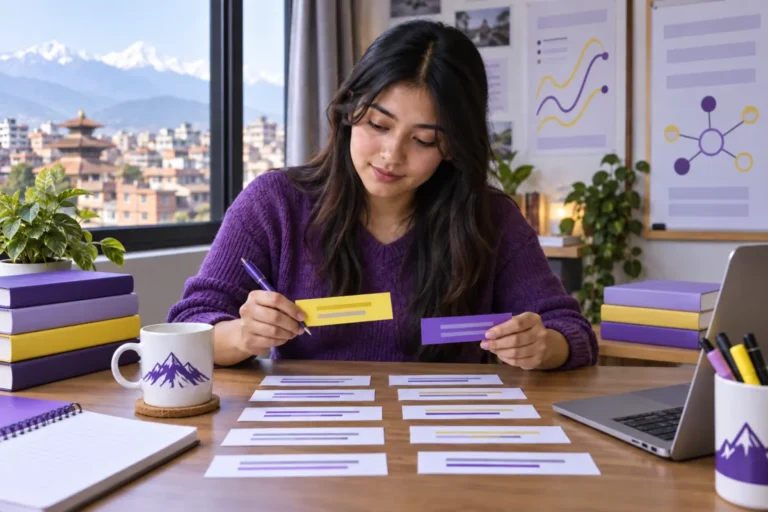
Record the original sentence, your predicted meaning, the verified meaning and one new sentence. Review cards in both directions: word to meaning and context to word. Mark whether a mistake came from an unknown word, ignored contrast, wrong tone or wrong grammatical form.
Use the Verbal Ability hub and CMAT grammar practice for the next step.
Questions and explanations are original MKS learning material. Study scenes are AI-generated illustrations.
Keep your preparation moving.
Explore the wider CMAT learning route or find current class information with MKSPrep.