MKS CMAT · Logical Reasoning
CMAT Directions and Relationships: Diagram Method and Practice
CMAT directions and relationships questions often feel confusing because students try to hold every turn or family link in memory. A small diagram removes that burden. Fix one reference point, add one fact at a time and answer only after the map is complete.
The following questions are original MKS practice, not official TU questions.
YOUR LEARNING ROUTE
Build the skill. Then apply it.
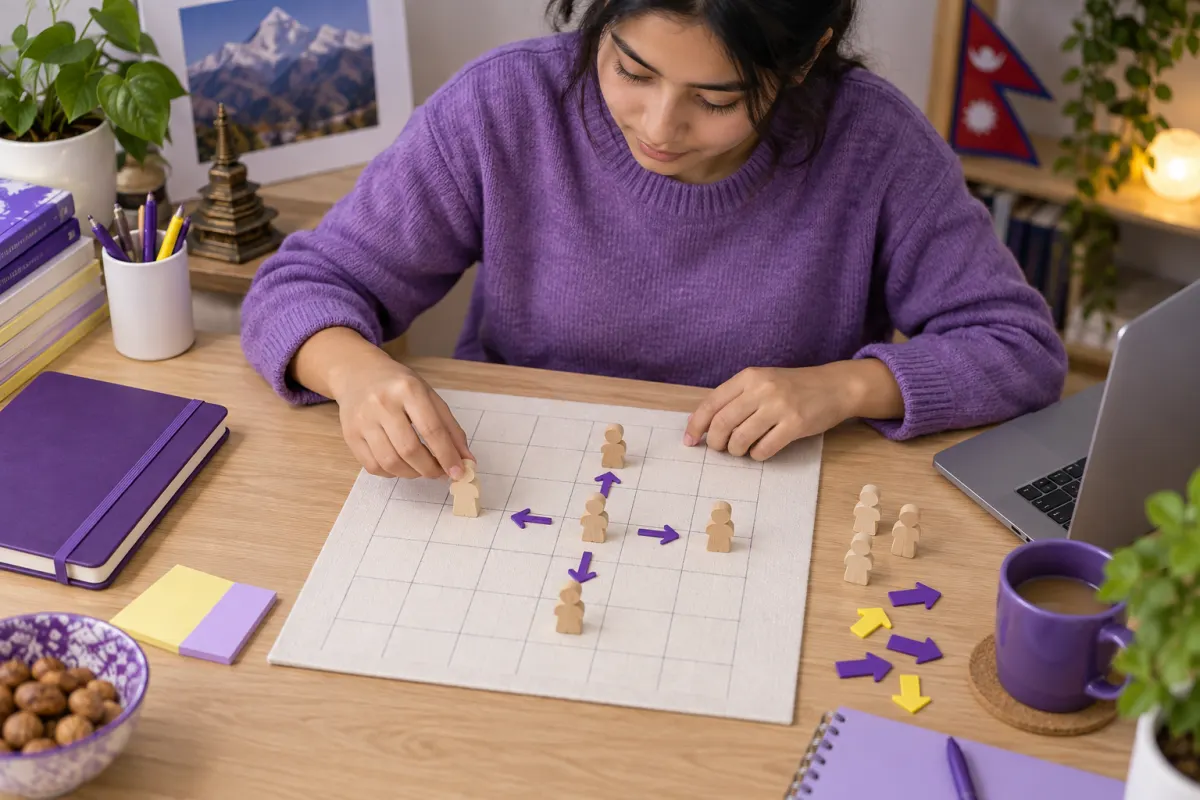
Draw directions on a coordinate grid
Use north as up, east as right, south as down and west as left. Start at (0,0). A movement north increases the vertical coordinate; a movement east increases the horizontal coordinate. If the final north–south movements cancel, compare only east and west.
For facing questions, draw an arrow before every turn. “Left” depends on the direction currently faced, not the top of the page.
Build a family tree with short symbols
Use a horizontal line for siblings and a vertical line for generations. Mark gender only when the statement provides it. Do not assume a cousin is male or that an unspecified parent is the mother.
PAUSE · CHECK · IMPROVE
Use the next section as an action step.
Keep your working and source notes. Record what was uncertain, then choose one small correction or verification task before moving on.
Six original questions
Q1. Final direction
Asha walks 4 km north, 3 km east and then 4 km south. Where is she relative to her starting point?
- A. 3 km east
- B. 3 km west
- C. 4 km north
- D. At the starting point
Q2. Turning
Biraj is facing west. He turns left, then left again. Which direction is he facing?
- A. North
- B. South
- C. East
- D. West
Q3. Aunt relationship
Rina is Kiran’s sister. Kiran is Maya’s father. How is Rina related to Maya?
- A. Mother
- B. Aunt
- C. Sister
- D. Grandmother
Q4. Maternal uncle
Anu is Bina’s mother. Chetan is Anu’s brother. How is Chetan related to Bina?
- A. Brother
- B. Father
- C. Maternal uncle
- D. Paternal grandfather
Q5. Position map
P is north of Q. R is east of P. S is south of R. Where is S relative to Q?
- A. North
- B. South
- C. East
- D. West
Q6. Generation
T is the son of U. U is the sister of V. V is the daughter of W. How is W related to T?
- A. Parent
- B. Grandparent
- C. Uncle
- D. Sibling
Answers and diagrams in words
Q1 — A, 3 km east. North 4 and south 4 cancel. Only the 3 km east movement remains.
Q2 — C, east. From west, a left turn faces south. A second left turn from south faces east. Redraw the arrow after each turn.
Q3 — B, aunt. Rina and Kiran are siblings; Kiran is Maya’s father. Therefore, Rina is Maya’s aunt.
Q4 — C, maternal uncle. Anu is Bina’s mother, and Chetan is Anu’s brother. That makes him the mother’s brother.
Q5 — C, east. Put Q at (0,0), P at (0,1), R at (1,1) and S at (1,0). S is directly east of Q.
Q6 — B, grandparent. U and V are siblings. V is W’s daughter, so U is also W’s child. T is U’s son, placing W one generation above U and two above T.
Check assumptions before answering
Write only facts that the wording supports. A family-tree question may leave gender unspecified. A direction question may ask relative position rather than total distance walked. Use arrows and generation levels instead of relying on a mental picture.
Continue with the Logical Reasoning hub and number and letter series practice.
Questions and explanations are original MKS learning material. Study scenes are AI-generated illustrations.
Keep your preparation moving.
Explore the wider CMAT learning route or find current class information with MKSPrep.
One Comment